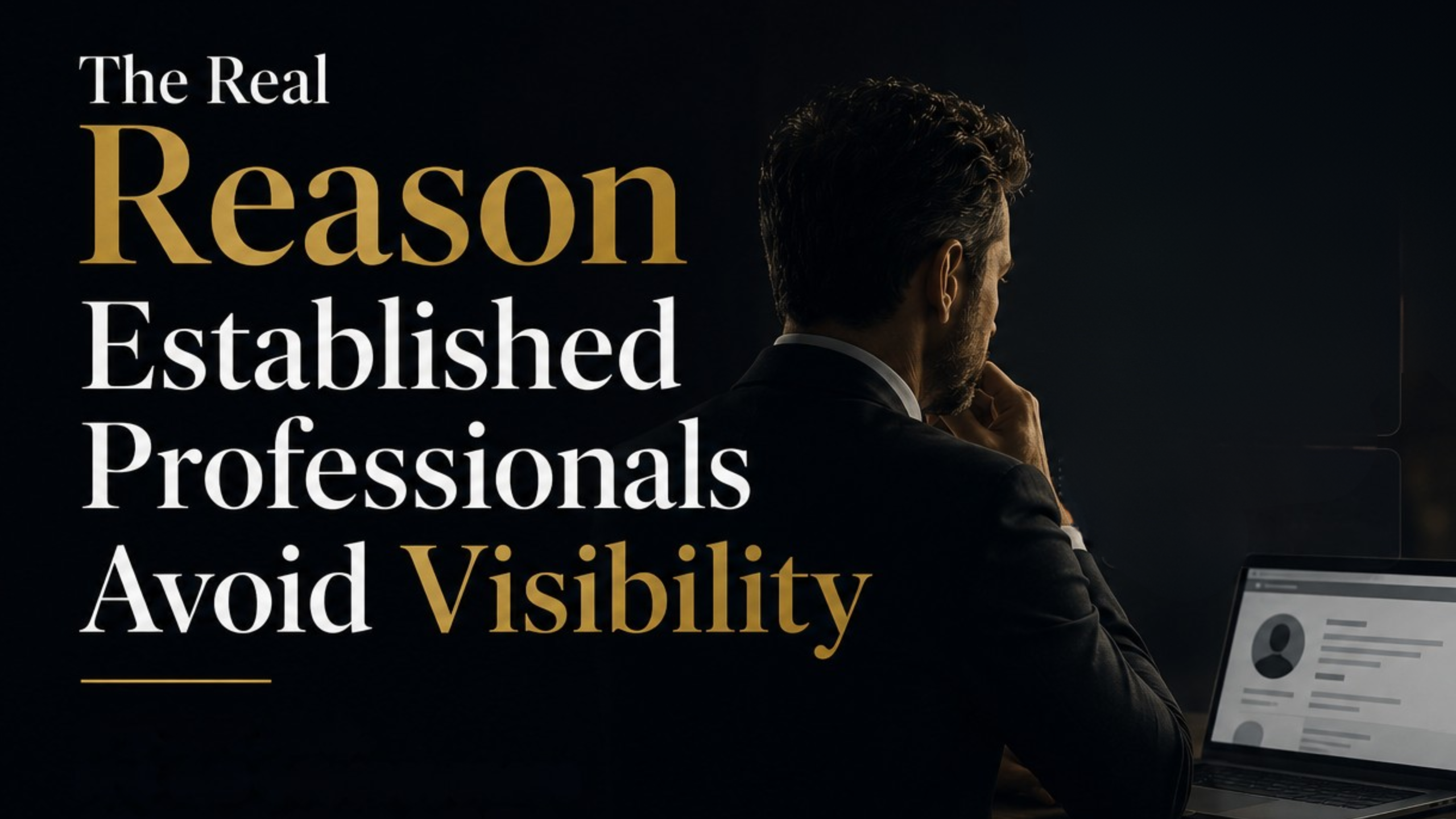
Most accomplished people do not resist visibility because they lack confidence.
They resist it because they have spent years protecting credibility.
That distinction matters.
The internet often frames visibility avoidance as fear, imposter syndrome, inconsistency, or mindset limitation, but for experienced operators, founders, executives, advisors, and respected experts, the resistance is usually far more intelligent than that.
Many established professionals instinctively understand something others do not: Visibility without precision can damage positioning.
If perception goes downward, it is difficult to recover.
The Problem Is Not Visibility
The problem is what visibility has come to represent. For many high-level professionals, it now implies:
- performative content
- oversharing
- manufactured thought leadership
- algorithmic behaviour
- inflated expertise
- constant self-promotion
- trading depth for attention
They do not want to become creators or personalities or dilute years of hard-earned reputation into a content strategy that feels commercially loud and strategically shallow.
It is right to be cautious.
Much of what is marketed as authority building today is actually visibility production.
Those are not the same thing.
Sophisticated People Protect Reputation Differently
Early-stage professionals often seek exposure.
Established professionals seek control of perception.
That difference changes everything.
The more senior someone becomes, the more they understand:
- reputation compounds slowly.
- perception shifts quickly.
- trust is difficult to restore.
- positioning affects selection.
- credibility is contextual.
At higher levels, visibility is no longer about being seen. It is about being understood correctly.
That is why many accomplished people unconsciously hold back.
They have the expertise but they fear becoming mis-positioned.
Many senior professionals have watched peers damage authority by speaking outside their strategic category, overproducing low-value content, appearing opportunistic, chasing relevance, adopting language beneath their level, and confusing visibility with influence.
The result is subtle but significant.
People begin to associate them with marketing activity instead of market authority.
Sophisticated buyers notice the difference immediately, especially at executive, investor, advisory, and founder level.
Branding is not the same as Authority positioning.
Most personal branding advice was not designed for highly accomplished professionals.
It was designed for discoverability.
That works for:
- creators
- early-stage consultants
- influencers
- audience-growth models
Established experts are solving a different problem. They are not trying to become visible from nothing.
They are trying to become strategically undeniable, and that requires a different architecture entirely.
The objective is not maximum exposure.
The objective is accurate authority.
Real Authority Often Becomes Quieter
One of the biggest misconceptions in authority positioning is that influence always looks louder.
Often, true authority becomes more refined, selective, specific and controlled.
People with genuine market authority rarely need to constantly announce expertise.
Their positioning does much of the work before they enter the room.
This is where many accomplished professionals feel relief for the first time.
They realise authority positioning is not about becoming someone else.
It is about ensuring the market finally understands the value that already exists.
The Hidden Cost of Staying Invisible
However, there is another side to this. Many highly capable people quietly become under-recognised for years, because the market cannot accurately categorise them.
This creates a frustrating dynamic:
They are respected but not selected, trusted but not elevated, and experienced but not fully understood.
Over time, this gap compounds commercially.
The market increasingly rewards people who are easy to position mentally.
Authority Positioning Should Never Feel Performative
If visibility strategy requires you to behave beneath your level, the strategy is wrong.
Sophisticated positioning should:
- increase precision
- elevate perception
- strengthen category association
- create strategic clarity
- reduce explanation fatigue
- deepen trust
- improve selection dynamics
Not force personality performance or manufacture relevance.
The strongest authority positioning often feels less like self-promotion and more like structural correction.
The market finally sees what was previously difficult to articulate.
The Real Difference
The people who build enduring authority are rarely the loudest.
They are the clearest.
They understand that authority is not built through visibility alone.
It is built through perception, positioning, categorisation, and trust.
For established professionals, that distinction changes whether visibility feels threatening or strategically valuable.
The issue was never visibility itself.
It was whether visibility would preserve the integrity of who they already are.
That is the real reason many accomplished people hesitate, and why the right authority positioning work feels fundamentally different from personal branding.
Continue reading How Intellectual Authority Is Constructed at Senior Level
Or request access to The Authority Assignment Brief, a complimentary brief on how authority is assigned, reduced, and structurally reinforced.
Donna Kennedy
Authority Positioning Specialist
– Positioning leaders, entrepreneurs, and experts to build authority and executive presence through behavioural intelligence, strategic communication and intellectual assets.