
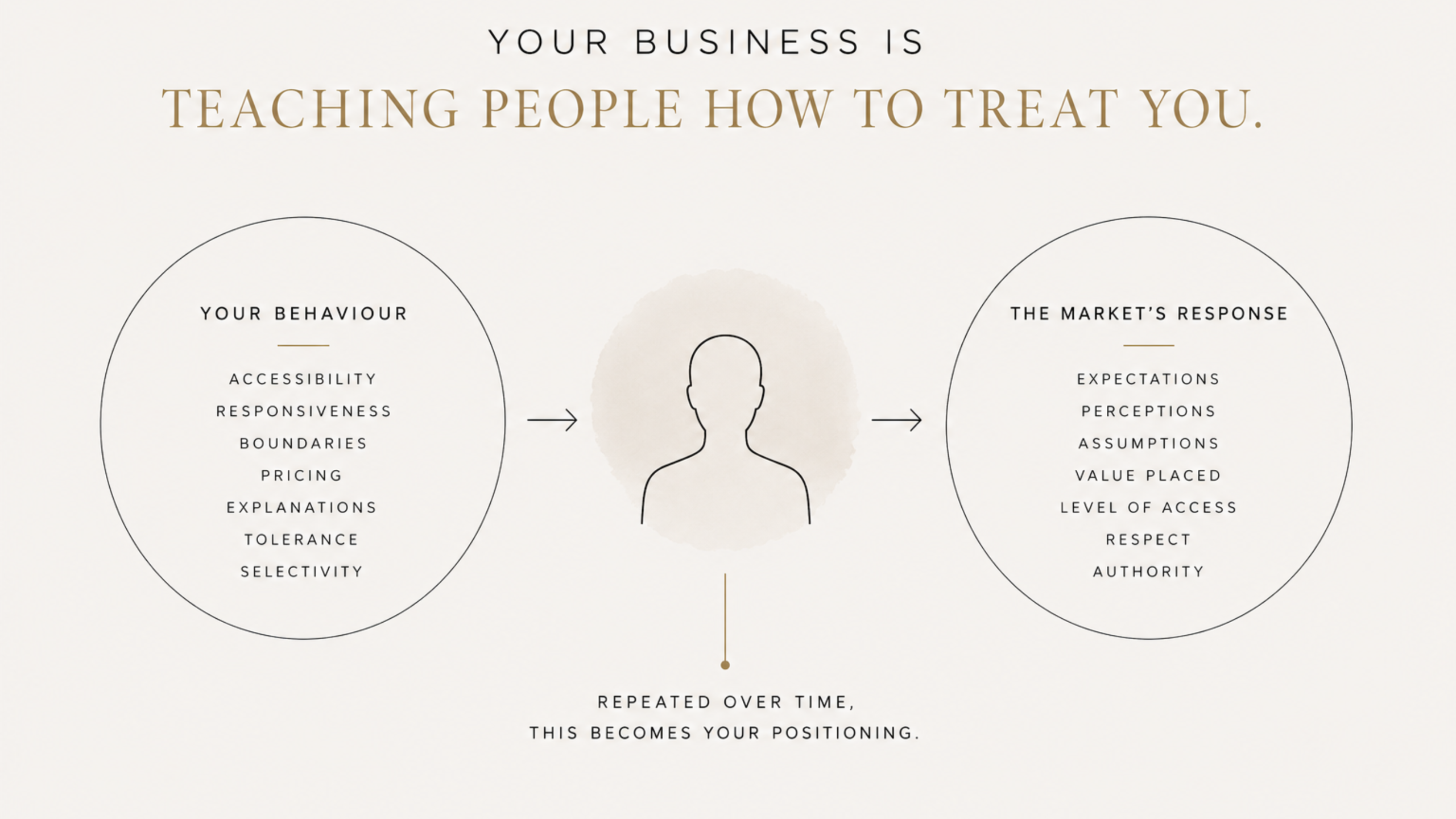
Most entrepreneurs believe the market responds to what they say about their business. Often, it responds more powerfully to what their behaviour teaches people to expect. This happens quietly over time.
Every interaction reinforces perception. Every decision communicates positioning. Every tolerance establishes a standard. Long before founders realise it, their business has started training the market how to value them.
Behavioural psychology has shown for decades that people quickly form expectations through repeated patterns and reinforcement. In business, those patterns become commercial signals. Markets learn not only from what founders claim, but from the behaviours surrounding the claim.
This is one of the least understood dynamics in authority positioning because most entrepreneurs focus almost entirely on growth, visibility, strategy, sales, and execution while paying very little attention to behavioural conditioning.
Markets are constantly learning from behaviour.
They learn how quickly they can access you. How much reassurance you provide. How flexible your boundaries are. How urgently you respond. How available your expertise feels. How easily your pricing moves. How selectively you operate. How strategically you position yourself.
Over time, these patterns become psychological instructions. And eventually, the market starts responding to those instructions automatically.
This is why many highly capable entrepreneurs unknowingly create commercial dynamics that quietly weaken authority over time. Their behaviour teaches the market to experience that expertise at the wrong level.
Constant availability teaches people immediate access is normal. Over-explaining teaches people reassurance is required. Excessive responsiveness reduces perceived scarcity. Tolerating poor-fit opportunities weakens positioning. Chronic visibility can reduce perceived significance. Repeated underpricing conditions lower-value expectations.
None of this happens consciously. But perception rarely does.
Human beings constantly interpret behavioural cues to determine value, authority, leadership, confidence, importance, and replaceability. Research in behavioural economics and social psychology consistently shows that people use shortcuts and signals to make rapid judgments long before complete information is available.
This becomes especially important at higher levels of business because sophisticated markets increasingly evaluate perceived standards before direct experience fully occurs.
This explains why some entrepreneurs remain trapped in commercial dynamics that no longer reflect the level they actually operate at.
The founder may have evolved. The business may have evolved. The expertise may have evolved. But the behavioural patterns surrounding the business never evolved with them. The market is still responding to an earlier set of signals.
This creates invisible positioning friction.
Clients continue expecting lower-level access. Pricing resistance remains high. Boundaries become difficult to reset. The business feels respected but not elevated. Valuable but not premium. Capable but still psychologically accessible in ways that reduce perceived authority.
This is where many founders become exhausted without fully understanding why.
They continue trying to solve the problem through harder work, more visibility, more delivery, more responsiveness, and more proving without recognising that the issue is behavioural positioning.
The business has unintentionally trained the market into certain expectations.
Markets rarely change those expectations automatically.
This is one of the reasons authority positioning becomes commercially critical as businesses mature. Higher-level positioning often requires behavioural recalibration. It requires alignment.
The behaviour surrounding the business must begin matching the level the founder now operates at.
A business communicates standards, selectivity, confidence, clarity, authority, and strategic value through behaviour as much as messaging.
People begin assuming expertise carries weight. Time becomes perceived as valuable. Access feels meaningful. Positioning feels intentional. Authority begins forming before direct interaction even occurs.
Sophisticated authority positioning is rarely performative. It is pre-assignment and behavioural consistency between expertise, standards, communication, visibility, accessibility, and commercial expectations.
Markets are always learning how to treat you.
Over time, the behavioural economy surrounding a founder often becomes more influential than the founder realises.
This is why some entrepreneurs unknowingly outgrow the behavioural patterns that originally built their business. The company evolves. The expertise evolves. The authority level evolves. But the market is still responding to old conditioning.
Unless those signals change, the business often continues attracting opportunities aligned with an earlier version of the founder rather than the level they now operate at.
The market is constantly learning how to value your expertise.
The question is whether your behaviour is reinforcing the level you actually operate at.
As businesses evolve, authority becomes increasingly consequential.
Donna Kennedy
Authority Positioning Specialist
– Positioning leaders, entrepreneurs, and experts to build authority and executive presence through behavioural intelligence, strategic communication and intellectual assets.